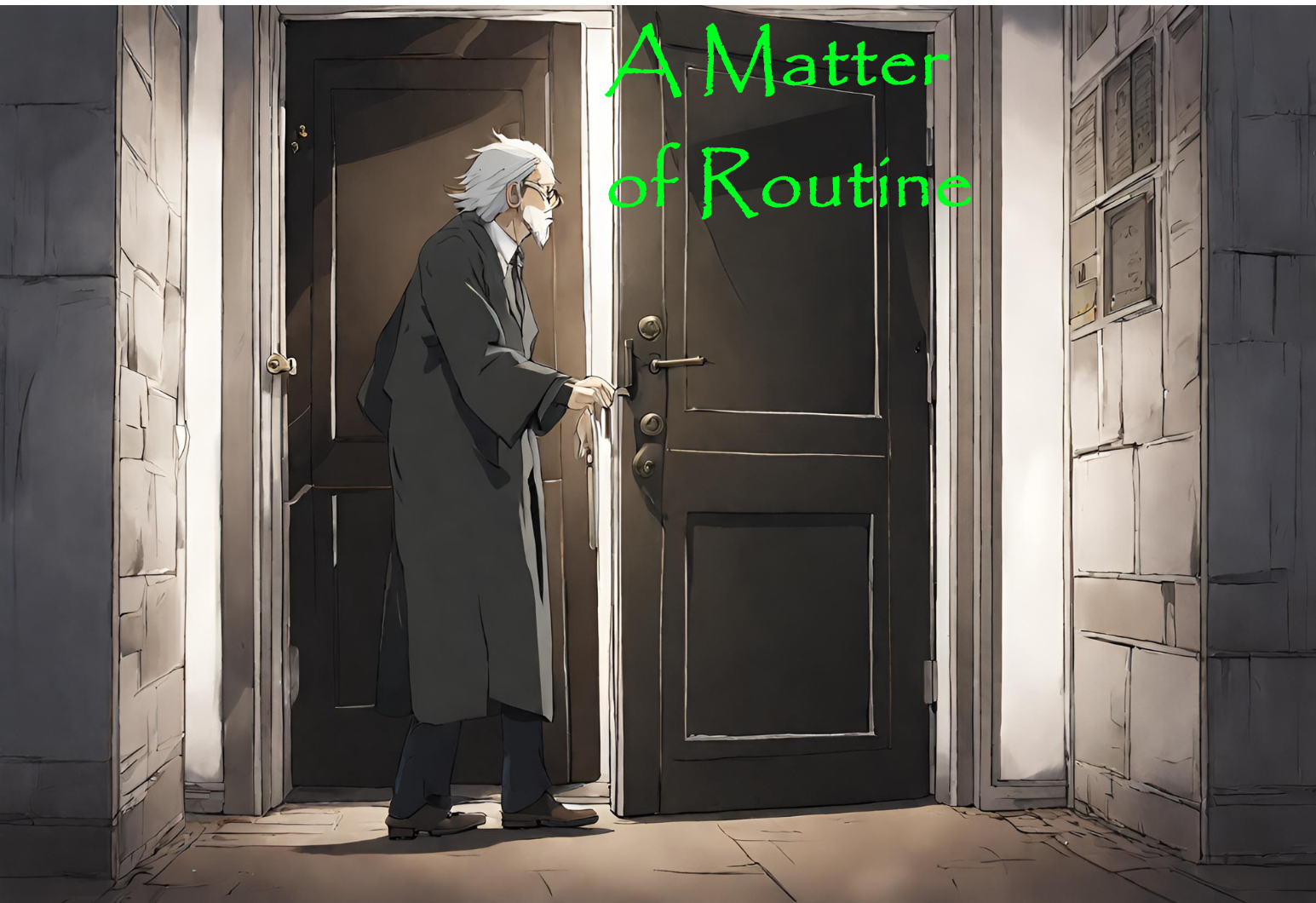
A Matter of Routine
A Short Story from Morbid Ink Magazine
The silver moon shone through the leafless branches of trees, casting eerie shadows over the quiet neighborhood. Mr. Shaver stepped out of his apartment at precisely nine o’clock, feeling the chill of the October wind rush against his face. The scent of fall filled his nostrils, mixed with a faint hint of wood smoke in the distance. He strolled down the street, his hands pushed down inside his camouflage green coat. A knit cap kept his long hair out of his eyes and covered the bald spot spreading on top of his head.
As Shaver passed by 816 Elm Street, he grumbled to himself about having to step off the sidewalk. A section of newly laid concrete lay in his way and he maneuvered around the boarded-off area near the driveway. Then, the man noticed the streetlight at the corner was out; he frowned.
Typical of our growing mediocrity.
Automatically, he continued down Elm Street, his thoughts lost to a recent paper which caught his focus. His mind whirled around the work completed by Wheeler concerning space-time and what the renowned physicist called quantum foam. His short legs followed the familiar path as his mind delved into the complexities of the journal he read.
Eventually, he would stop at Walter’s Vape Shop. Every night, he would enter the shop and greet the man behind the counter with a nod before purchasing a replacement pod for his e-cigarette. With the black box in hand, Mr. Shaver would continue down Daytona Street until he reached Peach Street. Then he automatically turned left and made his way back to Elm Street via Lincoln Avenue. The entire route took him exactly 45 minutes, and he always arrived back at his front door at precisely 9:45 PM. Then, he would return to his work.
As he walked, Mr. Shaver would occasionally encounter people, but they rarely said anything to him. Known as the eccentric fixture of the neighborhood, most people simply avoided him. Even the man at Walter’s Vape Shop remained silent during their interactions, knowing that Mr. Shaver preferred it that way. With a tap of his fingers on the glass counter while holding the exact amount with tax in his hand, he would purchase what he needed. Ignoring the customary thanks, he would quietly leave the store, resuming his slow and deliberate pace around the block.
Those who took notice of Abraham Shaver could sense the need for seclusion. As he trudged along, his heavy army surplus coat and woolen cap pulled low over his long gray hair, many assumed him to be a destitute wanderer. But only a handful would realize that he was once a distinguished academic. With doctorates in both philosophy and physics, Shaver had been a renowned authority on Aristotle and Plato. His works inspired and guided younger colleagues with his ground-breaking ideas. His publications argued against the technology that lacked ethical safeguards. He held technology as an existential threat, becoming so ingrained in society as to destroy humanity.
However, that belief did not bring him down. No, his name sparked a wildfire of controversy for another reason. His beliefs ignited an inferno of scandal in academic circles at the small college. Not reflecting upon history, people whispered with horror and disdain, accusing him of dangerous thoughts. Mr. Shaver became a threat to their complacency, for he wanted students to think critically. He pushed Platonic rationalism and Aristotle’s deductive reasoning on students. He asked them to think critically instead of blindly accepting what their teachers and classmates said.
He dared to expose traditional ideas of academic rigor and rational discourse to students over secular theology, which brought about a revolt. As a result, he paid the price by losing his job because of the backlash from those administrators who deemed themselves “right thinking.” But even in exile, at first, he stood tall and unyielding, refusing to let their pettiness and obliviousness silence him. However, the fight turned his family into social outcasts, creating an unbearable tension between husband and wife. The event eventually broke him when he lost that one person who he deemed the most important to his world.
The solitary man took in his surroundings without dwelling on the past, since he remained fixated upon Wheeler’s paper. He could not help but feel a twinge of nostalgia for his long-lost tobacco habit. Still, the ex-professor occasionally liked to sniff an expensive cigar, even if he could not afford to buy one. His doctor’s order prompted Shaver to make the change for the sake of his health. So, each night he would take this route to pick up a refill for his vaping habit. This was one of the few major shifts in his life over the last few years; everything else seemed to remain stagnant and unchanging. Shaver liked it this way.
As Aristotle would say, quality is not an act, it is a habit.
When he reached the intersection of Jefferson Street, Shaver frowned to himself. Something felt off, like he missed something. He looked around, then shrugged, dismissing a feeling that made no logical sense. Over the years, he has lived his life like a clock. Every day, he did the same thing at the same time. Certainly, the number of footsteps remained the same.
His routine wasn’t a conscious decision. However, Shaver found comfort in the regular habits. It came naturally after losing his wife to the overwhelming social chaos she endured with him. Luckily, she didn’t divorce him. She still sent him checks each month to allow him the pleasure of researching ancient manuscripts and books inside his apartment. His timed existence became a way to refresh his mind while tackling complex philosophical and physics questions.
As he turned onto Peach Street and headed back towards Jefferson, the dog that always barked at him was waiting once again. As always, Mr. Shaver ignored the snarling animal that raced back and forth inside its fenced yard. The beast eventually gave up trying to chase him when he stepped in front of the next house.
Shaver came to an abrupt halt in front of the quaint house at 213 Peach, his progress impeded by several large boxes scattered across the sidewalk. He couldn’t help but notice the couple standing on the porch, their agitated voices carrying over the yard. Through an open front door, he caught snippets of the conversation as a disheveled man bolted past him, arms laden with hastily packed suitcases. The man flung the items into the waiting car’s open trunk before once again disappearing into the house.
Curiosity piqued, Shaver tilted his head and gazed up at the porch where the man’s distraught wife stood clutching their crying infant. Tears streaked down her cheeks as she urgently urged her husband to hurry.
For a moment, Shaver overheard the sound of a faint newscast drifting from the open living room door.
“… we have reports of buildings gone . . . missing people. . .Dr. Hardwick . . .” The wind whipped the muted words away and Mr. Shaver shrugged as he stepped through the obstacles and continued on his way.
Authorities are scaring the populace again!
He’d heard it before. Atomic weapons hidden in a Middle East desert to start a war to enrich the super wealthy. Terrorists flying planes into buildings, leaving the populace happy to give up their freedoms. Logic and rationality always fell by the wayside when people turned into blithering puppets driven by fear and emotions.
The Hardwick name came to his mind as he remembered the braggart loved to move everyone. A trained monkey who enjoyed sitting for interviews with intellectual inferiors like himself. Shaver’s objections to Hardwick’s experiments on quantum physics and braneworlds played a role in the ex-professor’s current state. He lost vital friendships when he pointed out the potential issues of pushing through the curtain separating dimensions.
Despite the nagging thoughts that crept into his mind, Shaver shook them off and vigorously rubbed his arms together as he breathed in the crisp, chilly air. He quickened his pace, taking in the familiar sights of the neighborhood that emerged from the dark fall night.
He reminded himself of the mantra he had adopted a decade ago to remain sane — nothing in the world would phase him. Isolation and resilience remained the keys. With a determined stride, he continued on his way, confident in his ability to stay calm and collected. In a way, he even went against the advice of the great one he knew well. Aristotle claimed those who enjoyed solitude were a beast or a god.
Well, I’m certainly no god.